
FERC Orders 918 & 919: Why Compliance Alone Is No Longer Enough for Critical Infrastructure Security
The energy and utilities sector is entering a new era of cyber-physical resilience.
With FERC Orders 918 and 919, regulators are signaling a fundamental shift: securing critical infrastructure can no longer rely on fragmented controls, periodic audits, or siloed security teams. Instead, utilities must rethink how they manage identity, access, workforce operations, contractors, and cyber-physical risk across increasingly distributed environments.
The question is no longer:
“Are we compliant?”
The real question is:
“Are we operationally resilient?”
The New Reality of Grid Security
Electric utilities today face unprecedented complexity.
Distributed substations, remote operations, contractors, mobile workforces, third-party vendors, virtualized infrastructure, OT systems, and cloud-connected environments are expanding the attack surface faster than traditional security models can keep up.
FERC Orders 918 and 919 recognize this reality.
These orders reinforce the need for stronger controls around:
Identity and access governance
Remote and privileged access
Protection of low-impact BES cyber systems
Security of virtualized and software-defined environments
Continuous monitoring and risk reduction
Modern security architectures, including zero trust
But here is the challenge:
1. Most utilities are still operating with disconnected systems.
2. Physical access lives in one platform.
3. Cyber access lives in another.
4. Contractor management exists somewhere else.
5. Compliance reporting is often manual.
6. Operational context is missing.
7. That fragmentation creates risk.
Why Traditional Compliance Models Are Breaking
Historically, many organizations approached NERC CIP compliance as an audit exercise.
Build policies. Generate reports. Prepare evidence.
Pass the audit.
Repeat.
But today’s threat landscape demands more.
A contractor badge misused at a remote substation, unauthorized after-hours access, remote OT connections without physical verification, or privileged access outside approved maintenance windows can create operational and security risks that compliance reports alone cannot prevent.
The future of compliance is not periodic.
It is continuous, contextual, and operational.
The Missing Piece: Cyber + Physical + Workforce Convergence
To truly address the intent behind FERC Orders 918 and 919, utilities must move beyond siloed security.
They need a unified operational model that connects:
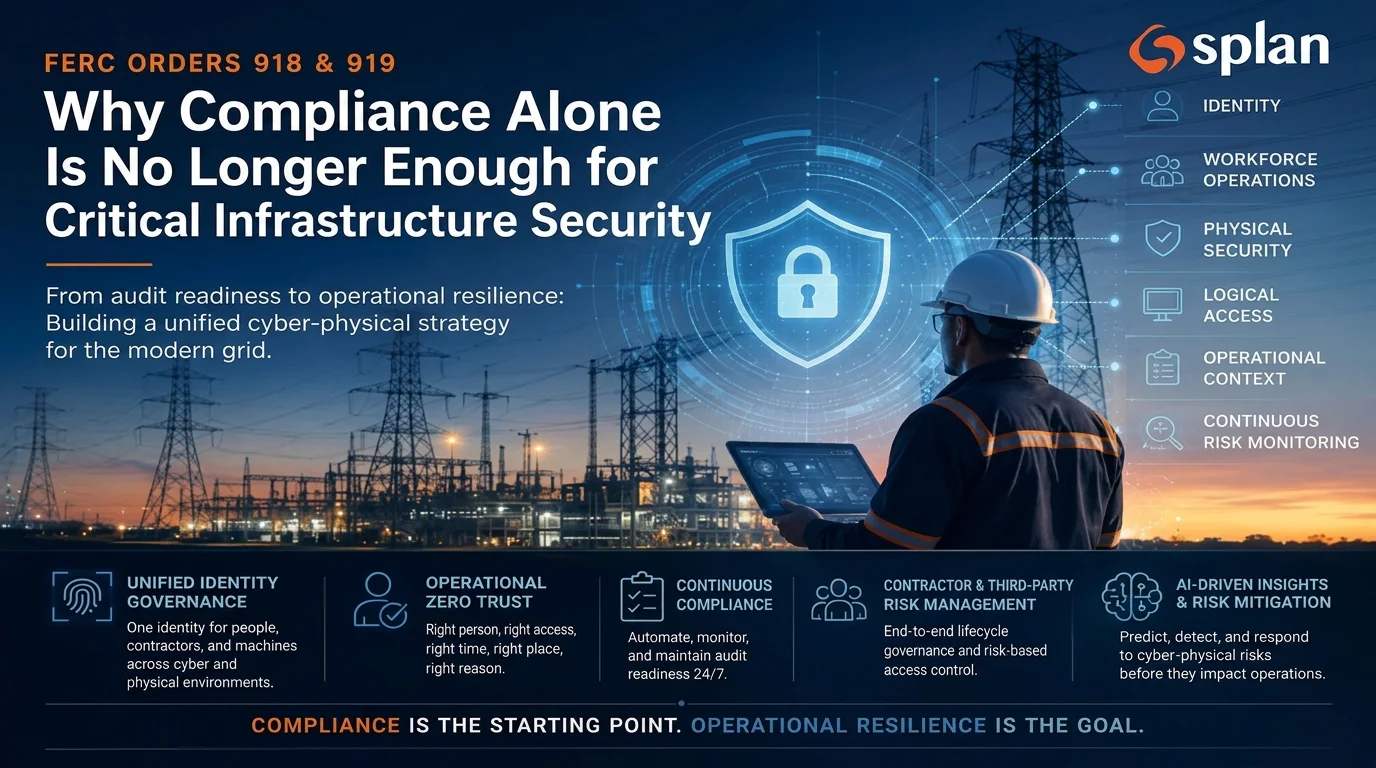
1. Identity
Who is accessing systems, facilities, and critical assets?
2. Workforce Operations
Are employees, contractors, and vendors authorized, trained, certified, and approved for specific work?
3. Physical Security
Who entered a site, when, and why?
4. Logical Access
Who accessed OT, SCADA, remote systems, or privileged applications?
5. Operational Context
Was the access tied to a valid work order, approved maintenance window, or operational requirement?
6. Continuous Risk Monitoring
Are abnormal patterns, policy violations, or insider risks being detected proactively?
This is where cyber-physical convergence becomes essential.
Why Utilities Need Operational Zero Trust
Zero trust is often discussed as a network concept.
But for critical infrastructure, operational zero trust matters even more.
Utilities must answer questions like:
Is the right person accessing the right facility?
Are they authorized for this task?
Is the timing expected?
Is the access aligned to operational approvals?
Does physical presence match remote system access?
Are contractor certifications current?
Is there unusual behavior that requires escalation?
Security should not rely on static permissions.
It must be dynamic, contextual, and risk-aware.
From Audit Readiness to Continuous Compliance
One of the biggest burdens for utilities is audit preparation.
Gathering evidence across disconnected systems consumes enormous time and resources.
The next generation of security platforms will shift utilities toward:
Always-on compliance
Instead of chasing documentation, organizations should continuously automate:
Workforce entitlement validation
Contractor compliance
Temporary access governance
Visitor and vendor chain-of-custody
Access certifications
Exception management
Audit evidence collection
The goal should be simple:
Always audit-ready.
The Contractor Risk Challenge
Contractors and third-party service providers represent one of the largest operational and cyber risks in critical infrastructure.
Yet many organizations still manage contractor access manually or through disconnected workflows.
For modern utility operations, contractor access should be tied to:
Training completion
Safety certifications
Background checks
Work orders
Supervisor approvals
Time-based access policies
Location awareness
Maintenance schedules
Security and operations must work together—not independently.
The Path Forward
FERC Orders 918 and 919 are more than regulatory updates.
They represent a broader transformation in how utilities think about resilience.
The organizations that succeed will move beyond fragmented tools and compliance checklists toward a more integrated operational model—one that converges cyber security, physical security, workforce identity, contractor governance, and operational workflows into a unified system of trust.
At Splan, we believe the future of critical infrastructure security lies in cyber-physical operational intelligence where identity becomes the control plane for resilience, compliance becomes continuous, and AI-driven insights help organizations predict and mitigate risk before incidents occur.
Because in today’s environment, compliance is only the starting point.
Operational Resilience is the Destination.
Cyber-Physical Threat Detection, Prediction & Automated Remediation is the Future.
FAQs
FERC Orders 918 and 919 are regulatory updates focused on strengthening cybersecurity, operational resilience, and critical infrastructure protection for the energy and utilities sector.
These orders help utilities improve SCADA security, OT security, remote access governance, and continuous compliance monitoring to reduce cyber-physical risks.
Critical infrastructure protection involves securing power grids, substations, operational technology (OT), workforce access, and cyber systems from threats and disruptions.
The orders encourage utilities to move beyond periodic audits toward continuous compliance monitoring, risk-based access controls, and operational resilience strategies.
Operational resilience is the ability of utilities to maintain secure and reliable operations during cyber threats, physical incidents, or system disruptions.
SCADA systems control essential utility operations. Securing them helps prevent unauthorized access, cyberattacks, and operational disruptions across the grid.
Cyber-physical security connects physical security, identity management, workforce operations, and cybersecurity into a unified risk management approach.
Contractors often require access to sensitive facilities and systems. Proper governance ensures access is authorized, time-based, compliant, and continuously monitored.
Continuous compliance monitoring automates security checks, access governance, audit evidence collection, and risk detection to keep utilities always audit-ready.